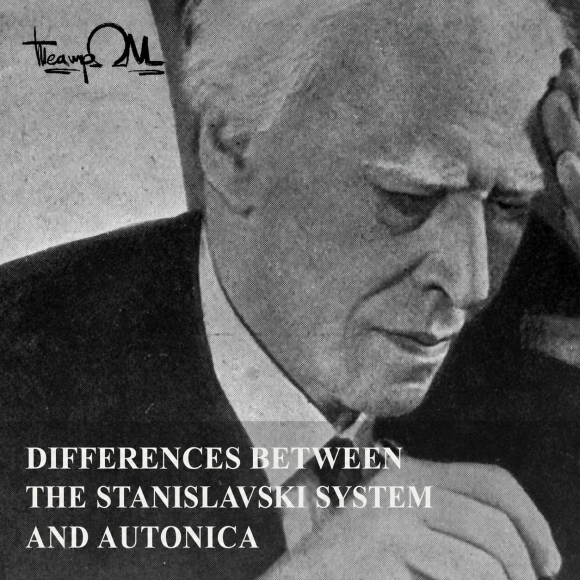
STANISLAVSKI AND AUTONICA: DIFFERENCES IN THEATRICAL SYSTEMS AND THEIR ETHICAL FOUNDATIONS
Two Fundamental Systems that Reveal Theatre as a Form of Truthful Action and as a Space in Which Life Emerges
When comparing Konstantin Stanislavski’s system with Roman Akimov’s Autonica System, it is important not to oversimplify either of them. This is not a dispute between the “old” and the “new,” but a distinction between two fundamentally different horizons of understanding theatre, the creative process, and the very position of the human being and the creator within it.
The Stanislavski system represents a profound reform of theatre aimed at overcoming both external and internal pretence. Stanislavski does not seek to “justify” acting; he seeks to eliminate its false nature. At the centre of his system is action as the foundation of existence on stage. The actor neither portrays nor demonstrates, but acts within the given circumstances, constructing a continuous through-line of behaviour governed by the superobjective. Through attention, imagination, and inner motivation, the actor attains an organic mode of existence on stage.
It is important to understand that, during the later period of his work, Stanislavski moved away from psychological explanations towards the Method of Physical Actions. This was an attempt to make the process objective, leading the actor away from subjective emotional experience and towards living action.
Stanislavski therefore takes a decisive step: he transforms theatre from an art of representation into a process of truthful action. Yet, despite all its depth, his system remains within the theatrical structure itself: the “I” acts within the given circumstances of the role.
The Autonica System begins from a different point.
It neither continues this trajectory nor deepens it within the same logic. Instead, it questions its very foundations: the role, the image, the production as a result, and art as a fixed form. This does not imply rejection, but an emergence beyond the closed circle of representation.
In this sense, Autonica also constitutes a profound reform, although not within theatre as an art form, but at the level of our very understanding of the creative process and the human being. Here, theatre is revealed as a sacred space in which authentic, new life can emerge beyond prescribed attitudes, schemes, and predetermined forms. It is a space where the pulse of being itself is laid bare, where a person encounters themselves, another human being, and that which exceeds their habitual understanding. Through this contact, or collision, the person arrives at awareness and inner transformation.
If, within the Stanislavski system, the actor strives for the truth of action, Autonica marks a transition from action to the conscious deed as an ontological act.
Ethics holds particular significance in Autonica. It is not a set of rules, but a way of attuning the position of perception. In the Stanislavski system, ethics appears as a professional demand placed upon the actor: truthfulness, discipline, responsibility, respect for the partner, and the pursuit of organic existence within the role. In Autonica, however, ethics precedes every action and determines whether the process itself can become possible.
The rejection of judgement, comparison, and hierarchy fundamentally liberates perception from structures that distort the human being from the outset and turn them into an object. Traditional theatrical thinking retains the possibility of comparison: better or worse, convincing or unconvincing, talent or lack of talent, “I believe” or “I do not believe.” Autonica dismantles the very foundation of these coordinates.
Every person is regarded not as a bearer of qualities subject to evaluation, but as a unique and irreducible phenomenon. This is an essential condition of the creative process: every judgement fixes and arrests the process, replacing the living with a scheme. The refusal to judge is therefore not a refusal of discernment, but a refusal to exercise power over another human being.
This is where the fundamental boundary lies. Stanislavski’s ethics is directed towards achieving truth within an already existing form. The ethics of Autonica is directed towards liberating a space in which life itself can manifest beyond fixed definitions, comparisons, and predetermined structures.
The central element of the Autonica System is not the role, but the phantom. The phantom is neither an image, a character, nor a function. It is the ultimate artistic and existential potential at the boundary between the possible and the manifest. It cannot be acted or reproduced. One enters into a process with it, and through this process a phenomenon emerges: an event in which something new is born rather than something already existing being interpreted.
In Autonica, theatre is neither a place of presentation nor the result of rehearsal. It is a space of manifestation in which the conditions for the emergence of life are created. A phenomenon cannot be reproduced or fixed; it can only occur. Within this process, the distance between actor and spectator disappears: everyone becomes a co-participant in a single event.
It is also important that Autonica cannot be reduced to an acting practice. Within the creative process, it reveals the inner world as an autonomous reality. It explores transformations of state, work with unconscious reactions, and the nature of supra-events. Here, the human being does not use themselves as an instrument of the role, but enters into the process of their own becoming.
It must be emphasised that these are not competing approaches, nor is one system “better” than the other. The Stanislavski System and the Autonica System are two fundamental, independent, and extensive systems, each revealing its own level of understanding the human being and theatre. They arise from different foundations, belong to different times, and respond to different questions.
As Roman Akimov, the creator of Autonica, observes:
“The Stanislavski System does not contradict us in any way, because it concerns something else. It is built upon entirely different principles and has different aims. It represents an important stage in the development of theatre, and I regard it with great respect. Had it not existed, perhaps this dialogue would not exist either, or it would have taken an entirely different form. I do not think anything can truly be separated: ultimately, we are all profoundly interconnected, in the broadest, cosmic sense.”
Despite their fundamental differences, the system of Konstantin Stanislavski and Roman Akimov’s Autonica System nevertheless share something essential. Both require engagement, inner work, attention, and responsibility for what is taking place, while rejecting formalism and empty technique.
In this sense, both are important and timely reforms. One purifies theatre from within, bringing it to the utmost truth of action. The other moves beyond its established boundaries, rethinking the very nature of theatre and the creative process. It is this shared striving for authenticity and the overcoming of false form that makes dialogue between them possible, despite the difference in their foundations.
Article compiled by Arseny Vorontsov.