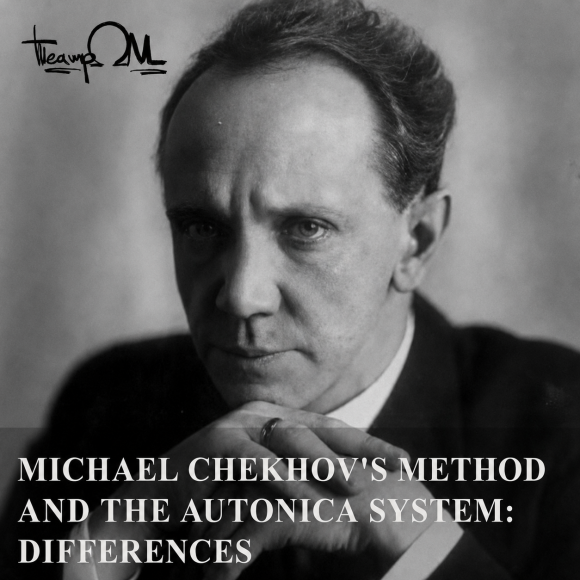
THE MICHAEL CHEKHOV METHOD AND THE AUTONICA SYSTEM: DIFFERENCES.
The Difference Between Two Fundamental Systems that Reveal Theatre as Artistic Embodiment and as a Process Through Which Life Emerges
Dear reader, this text is introductory in nature. Its purpose is to establish starting points for a deeper exploration of both Michael Chekhov’s method and Roman Akimov’s Autonica System. It is important to understand that a single article cannot encompass the full depth and scope of these approaches. It can only identify their principal differences and indicate a direction for further inquiry and dialogue.
It must also be stated from the outset that this comparative analysis is not entirely symmetrical. Michael Chekhov’s method is an independent and coherent system of actor training that encompasses a wide range of themes, principles, and practical exercises. The Autonica System, in turn, is an extensive structure consisting of seven interconnected methods, each with its own themes, principles, and practices.
Their philosophical foundations also differ. Michael Chekhov’s method draws substantially upon Rudolf Steiner and the anthroposophical tradition, which shapes its understanding of the human being, imagination, and the artistic process. The Autonica System is founded upon its own unique philosophical basis, from which all its methods, principles, and approaches to the creative process emerge.
This text therefore does not seek to equate or oppose these approaches. Its purpose is to identify the differences between their initial positions, opening a space for a deeper and more attentive study of each system.
Despite their apparent proximity, Michael Chekhov’s method and the Autonica System arise from different foundations.
Michael Chekhov’s method emerged as a means of overcoming psychological realism and the limitations of everyday emotional experience. It enables the actor to work not only through personal experience, but also through imagination, atmosphere, and psychological gesture. Within his system, the image becomes the central category, while the actor becomes a conduit for artistic reality.
The process moves from experiencing the role towards its poetic and metaphorical embodiment. The actor does not merely reproduce behaviour, but enters a higher level of artistic existence, where the inner and the outer unite within an integral image.
Yet, despite the depth and refinement of Michael Chekhov’s method, his system remains within the artistic logic of embodiment. However complex and multilayered the image may be, it remains the purpose and centre of the process.
The Autonica System begins from a different point.
It does not seek to develop more sophisticated ways of creating an image. On the contrary, it questions the very orientation towards image, role, and artistic fixation as the ultimate purpose of the process.
At its centre is not the image, but the phantom: neither a character, a type, nor an artistic form, but the ultimate tension of meaning situated at the boundary between the possible and the manifest. It cannot be acted or expressed. One enters into a process with it, and within this process a phenomenon emerges: an event in which a new reality is born rather than an existing one being interpreted.
If Michael Chekhov’s method seeks to make the actor a conduit for the artistic image, Autonica moves the process into another dimension: from expression to the creation of conditions. The Autonic does not so much embody something as create a space in which life becomes inevitable. This concerns not so much the logic of artistic expression as ontological becoming and the affirmation of a new artistic reality.
This distinction is also reflected in their understanding of the inner world. In Michael Chekhov’s method, the inner is revealed through imagination, atmosphere, a sense of form, and heightened imaginal thinking. It is directed towards artistic realisation.
In Autonica, the inner world becomes an autonomous reality of the creative process. Transformations, unconscious reactions, manifestations of symbols, and associative, archetypal, and ontological processes are explored not as means of creating an image, but as the foundation of the process itself.
Their understandings of theatre also differ.
For Michael Chekhov, theatre remains a space of artistic transformation in which a higher level of reality is revealed through the actor and the image. This is a powerful trajectory that leads theatre beyond the boundaries of everyday life.
Michael Chekhov envisioned the theatre of the future as a space in which the invisible dimension of reality would be revealed through the image, atmosphere, and actor. This striving to move beyond the everyday and encounter a deeper level of being became an important stage in the development of theatre. Yet within his system, this revelation remains inside the artistic logic: the invisible must acquire form, become an image, and be embodied.
In Autonica, the possibility of reaching an authentic process arises differently. It becomes possible not through the further development of this idea, but through the rejection of the very understanding of the theatre of the future as a space of artistic embodiment.
It is precisely this rejection that makes it possible to form an entirely different concept, one in which theatre is no longer understood as a place of expression and formalisation, but as a process in which something new emerges rather than being embodied.
In Autonica, theatre is understood as a space in which phenomena emerge and are created. It is not a place of presentation or embodiment, but an environment in which life arises. It is not a production as a result, but a phenomenon as an event of truth: an event of Aletheia in which that which is concealed undergoes existential disclosure.
Here, what is already known is not reproduced. Instead, that which previously had no form becomes manifest. Within this process, the distance between the Creator and the spectator disappears: everyone becomes a participant in a single event in which there is no mere observation, but co-being and co-participation.
Despite their fundamental differences, Michael Chekhov’s method and Roman Akimov’s Autonica System share something that makes dialogue between them possible. First and foremost, both possess a reverent and unconditional understanding of theatre as a distinct process that transcends craft and entertainment. In both approaches, theatre is connected with the profound dimensions of human existence and demands inner engagement, attention, and responsibility.
Moreover, some of Autonica’s methods go further. This is evident in their deeper engagement with the inner psychological processes of the human being: not only with imagination, fantasy, and imaginal thinking, but with the very nature of reactions, their emergence, and their transformation.
In this respect, the psychological gesture may, to some extent, be understood as an artistic intimation: a direction that, although not fully conceptualised in this way, indicated the possibility of a deeper exploration of inner and, subsequently, unconscious creative processes.
In this sense, Michael Chekhov’s method opened an important trajectory. It was later developed through a fundamental inquiry that led to the formation of the Reaction Method within Autonica, although according to an entirely different logic and upon a different foundation.
Article compiled by Antonina Govorkova.