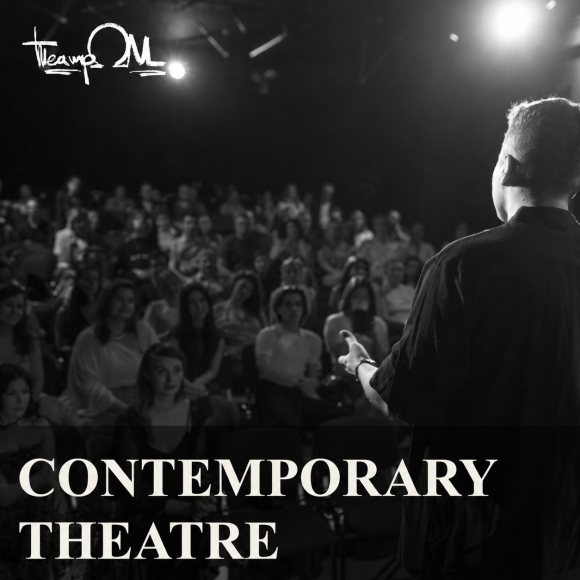
CONTEMPORARY THEATRE
Contemporary theatre is undergoing a state of profound inner contradiction. Never before has it possessed such an abundance of techniques, schools, and means of expression, and never before has the loss of what constitutes its authentic essence been felt so acutely. Behind the external complexity of forms, the virtuosity of performance, and the breadth of artistic diversity, a disturbing awareness increasingly emerges: theatre is not losing its language; it is losing the life within itself. That life is either replaced by form or dissolved in endless deconstruction.
The central question today is therefore not one of mastery, but an ontological question: what is actually taking place in theatre? Is it a space of reproduction and representation, or a space in which life emerges as an event? The Autonica System arises precisely at this turning point, not as yet another school, but as a transformation of our very understanding of the nature of theatre.
Traditional theatrical thought, regardless of its aesthetic differences, retains one fundamental principle: an orientation towards the result. The production and the role are constructed, fixed, brought to a completed form, and then reproduced. Even where the process involves profound inner work and achieves a high degree of organic existence, its underlying logic remains unchanged: form comes first, and the process is subordinated to it.
It is important to emphasise that this concerns more than theatre as an art form. It reveals a broader anthropological model in which the human being seeks to fix what is taking place, transform the living into a stable construction, and subordinate the process to its result. In this sense, theatre becomes a particular manifestation of a general mode of existence.
From Form to Emergence
Autonica proposes a fundamentally different point of departure. Theatre is understood not as a product, but as a process of emergence: not as something that must be shown, but as something that must occur. Form is no longer determined in advance; it arises as a consequence of what takes place.
What becomes essential is not the result, but the environment: the conditions in which the emergence of life becomes inevitable for both the Creator and the spectator. Theatre ceases to be a place of demonstration and becomes a space of becoming.
This is where the fundamental boundary lies. For all its diversity, the classical theatrical model is built around the category of the image: the actor forms, develops, and embodies it, while the process serves as the means through which it is achieved. Even the most profound systems preserve this logic: the image remains the centre, and the process remains an instrument.
In Autonica, this principle is suspended. The image as a representational form loses its status as both purpose and mediator. Along with it, the psychological mask also disappears: the mechanism through which a person “portrays” and “represents.”
At the centre lies a deeper level: the unconscious symbol and the phantom. The unconscious symbol is not a sign or image to be interpreted, but a dynamic structure in which the unconscious and consciousness enter into tension and interaction. The phantom is the ultimate state of this tension, a point at the boundary between the possible and the manifest, where meaning has not yet taken form but is already at work.
It cannot be reproduced or acted. One can only enter into a process with it, through which it may become a phenomenon, or may not emerge at all. Theatre thus ceases to be a space of representation and becomes a space of becoming, where the work is conducted not with form, but with the source from which form emerges.
The Deed, Space, and a New Reality of Theatre
No less significant is the shift associated with the deed. This is not a matter of returning to it, but of its emergence as a distinct mode of the artistic process. The deed is not opposed to action; it deepens action, carrying it beyond the boundaries of predetermined logic.
It is neither a simple choice nor a behavioural act, but an inner event of responsibility encompassing conscious, unconscious, and symbolic dimensions. Theatre ceases to be a zone of imitation and becomes a space in which the human being encounters the necessity to be.
This understanding unfolds through the dialectic of three interpenetrating spaces: physical, psychic, and artistic. They do not exist in isolation, but form a dynamic unity. Physical space establishes the horizon of life and the field of tension between order and disintegration. Psychic space is a multilayered environment of unconscious phenomena, images, symbols, and associations. Artistic space arises as an intervention: an act in which the physical and the psychic collide, undergo transformation, and give birth to a new reality.
A fundamental conclusion follows from this: theatre in Autonica can be described neither through mimesis nor through deconstruction. The age of reflecting reality, like the age of its endless dismantling, has exhausted itself. In their place comes a different understanding of theatre: as a space of awakening, the union of opposites, and the transformation of both reality and the human being.
From this perspective, theatre ceases to generate illusions and becomes a place in which a phenomenon manifests: an event possessing its own ontological integrity. Here, Aletheia comes into force. Theatre neither interprets nor explains; it reveals, making manifest that which previously had no form. Truth is not transmitted here; it happens.
This inevitably changes the position of the spectator. The spectator ceases to be an external observer and becomes a co-participant in the process. The boundary between stage and auditorium disappears, not formally, but essentially. Theatre becomes not the transmission of meaning, but an encounter in which everyone is involved in what is taking place.
Theatre as Limit and Beginning
At this limit, theatre ceases to be art in the conventional sense of the word. It moves beyond the boundaries of form, profession, and even culture itself. It becomes an event of being: a point at which the human being truly encounters the very fact of their own existence for the first time.
It is no longer possible to hide behind an image, a role, or a technique. All mediators disappear. Only tension remains: between life and its absence, between possibility and its realisation, between that which does not yet possess form and that which strives to become form.
In this understanding, theatre is not a place where life is shown, but a place where life emerges. It is neither reflection, play, nor statement, but an act of emergence.
An act in which the human being is no longer an observer or performer, but a participant in an existential and ultimate process where every moment is a choice.