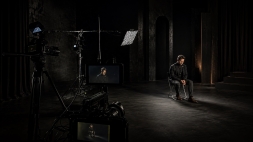
ROMAN AKIMOV’S AUTONICA: ART AS A GUIDE TO THE INNER WORLD
Roman Akimov is a director, Artistic Director of Theatre OM, and creator of the Autonica system. He emerges as a profound thinker for whom theatre is neither an arena for debate nor a means of conveying ideas, but a space of inner encounter and shared ontological inquiry. His philosophy rejects judgement and the imposition of views, focusing instead on creating the conditions for free choice and awakening perception in both the artist and the spectator.
Roman Evgenievich, Autonica, a system for training artists, is often described as your calling card as a director. How did the idea of making the unconscious visible arise?
I would not call Autonica my “calling card.” There is something illusory in that definition, something rooted in representation and the desire to define oneself. After all, a calling card must constantly be handed to someone; one has to be persistent, even cunning. In that sense, I do not think Autonica ever belonged to me.
What matters, perhaps, is something else: throughout our interaction, it created me far more than I created it. I was, and remain, like a writer who follows what is being born rather than inventing it in advance. I simply followed it, trying to hear and understand where it was leading.
The people who appeared along the way came almost by chance. Then there were so many of them that the process itself acquired scale. I merely shared what I had discovered and where I intended to go next. I am a conduit.
As for making the unconscious visible, the concept is essentially abstract. It does not refer to an image, but to a person’s encounter with their inner processes, to the moment when the inner becomes visible. The idea arose not as a theory, but as an inner event: suddenly, like a line from a poem that appears without warning. It then took a great deal of time to comprehend what had happened and transform it into a living practice.
In your view, has artists’ perception and understanding of theatre changed over the eight years of the system’s existence?
The very idea of “changing people’s views” is alien to me. I try not to exist within that field at all, because views are invariably connected with judgement. And judgement is something I actively struggle against, first and foremost within myself.
The desire to change people’s views leads to conformity, to imposing an idea of how things ought to be. From that position, you inevitably place yourself above the person you are speaking to, one step higher. I do not build staircases. It dehumanises us.
In Autonica, I create the conditions for choice rather than a system of beliefs. What matters to me is not directing someone, but offering them the possibility of seeing the process from another perspective.
More than a century ago, Konstantin Stanislavski created his system, which is followed by thousands of artists. Do you agree with it, or does it contradict your understanding of the performing arts?
It does not contradict it, because it concerns something else. It is built upon entirely different principles and pursues different aims. It represents an important stage in the development of theatre, and I regard it with great respect.
Had it not existed, perhaps this dialogue would not exist either, or it would have taken an entirely different form. I do not think anything can truly be separated: ultimately, we are all profoundly interconnected, in the broadest, cosmic sense.
In your productions at Theatre OM, you explore subjects of urgent contemporary relevance. What ideas or feelings do you seek to convey to the audience? And do you enjoy entering into a debate with them?
For now, I think the most important thing is to resolve all the practical matters concerning the theatre space. After that, I want to continue the mutual enrichment and dialogue between dramatic works that are fundamentally different in nature.
Within the trilogy I am creating, The Awakened Human Being, following Emanation of the Dark, based on Shakespeare’s Macbeth, I want to create Emanation of Light. The collision between them must lead to a choice, to an inner turning point. That will become the third play.
For the moment, I am thinking, somewhat abstractly, about Jean Anouilh’s Eurydice, and about a new mode of stage existence for artists, actors, and Autonics.
I also want to explore Artyom Novichenkov’s play Manfred, Siegfried, one of the most powerful works of our time, perhaps, both dramatically and poetically. I was able to read a fragment of it, and it made a very deep impression on me.
At present, I feel that I am only beginning to live. And there is so much that must be accomplished before life comes to an end.
At the legendary Stanislavski House Museum, you founded the First Public Theatre Guild. What lies behind the idea of bringing together everyone who wishes to become involved in the acting profession?
That house is a profoundly important symbol for us. It embodies the continuity of theatre history and, in essence, our inheritance. The same is true of the idea of public accessibility, which we did ultimately succeed in realising. That is one of our greatest achievements.
This is less about involvement in the acting profession than about participation in a creative and professional process as such. The Guild brings together numerous professional disciplines and studios. Ultimately, they meet within the theatrical space and reveal their potential through productions.
One of the Guild’s central principles is the unification and consolidation of creative forces. It existed at the Stanislavski House for exactly one year. Then the process began to expand: new studios emerged, the number of participants grew, and we moved to another space.
Now, in essence, we find ourselves in the same situation once again. The process of movement and growth continues. It is not an easy process, but I believe we will manage.
You devoted a book to this area of your work. Which aspects did you consider most important to explore?
Yes, a book was published under the title The First Public Theatre Guild. It can be discovered and purchased in any convenient way, from anywhere in the world.
The book reflects all the processes taking place within the Guild, but I am not its sole author. I am merely the person who created the conditions for it to emerge and became one small part of this collective undertaking.
The book has been successful because it is not simply a collection of texts, but a theatrical and deeply psychological inquiry. In December 2025, a second book will be published, encompassing the entire second year of the Guild’s existence.
You also have a love of playwriting. The Wondrous Flute of Toshiro came from your own pen. What led you to create this work?
It came from a small, old pencil.
Autonica has a principle: creation as an act born of impossibility. I try to remain faithful to it. In truth, I simply wanted to create the play.
The Wondrous Flute of Toshiro is part of my collection of plays, For Grown-Ups and Children. The book emerged from an exploration of different traditions and cultures and their inner interconnectedness: in this case, ancient Japan, ancient Europe, and ancient Scandinavia.
Three plays for the theatre were born from this inquiry, one of which is The Wondrous Flute of Toshiro. Yet the one closest to me is The Planet of Fools.
The book truly is for grown-ups and children. It is best when they gather together and read it aloud as a family, each taking a part. To turn the attention of fathers towards their children, and the attention of children towards their parents, is, I know, part of my mission.
In your dialectical work, you write about the unity and interconnectedness of spaces, phenomena, images, symbols, and associations. Which findings of your research surprised you?
This world is nothing like what it appears to be to any of us.
Your talent has received recognition both in Russia and internationally. What does recognition mean to you, and how does it affect the development of your creative and professional work?
I regard it calmly and build no expectations around it. At times, what you have described as recognition can even become an obstacle.
When speaking with people, I often feel that they have created an image of me based on what they have read rather than on the direct experience of encountering me as a living human being. They see not what is there, but what they would like to see.
And when what they have projected onto me does not coincide with, reflect, or manifest the processes of their own inner life, they become disappointed and even angry. I feel deeply for them. But this, too, is a process.
What advice would you give to emerging directors taking their first steps in art?
When everything around you becomes confused and entangled, when the moment comes in which darkness has enveloped every shore, preserve your heart.
Do what must be done, and know that what is meant to come will come. This is precisely the moment when everything is turned towards you and rests upon you, because you can see beyond what appears possible and are capable of making tangible and visible what is concealed.
As it was once said: do not be afraid.
What I have said does not mean that anyone is worse or better than you. It is time to part forever with these judgements, and with the many others that resemble labels hung upon a person.
The path before you is difficult, but it is also beautiful, as is the path of every person around you. We are all one and indivisible. A healthy tree neither compares itself with nor competes against the natural world surrounding it. Only through their unity can healthy fruit emerge.
Be perfect.
I know all the difficulties of your path, especially those moments when your strength deserts you and you no longer know where to go or where you will sleep. I also know the tremendous resistance that arises in those terrible moments when everything seems to be taking on the nature of destruction.
Yet I will tell you this: it is in moments of utter despair that a fair wind from the East begins to blow more powerfully than ever.